
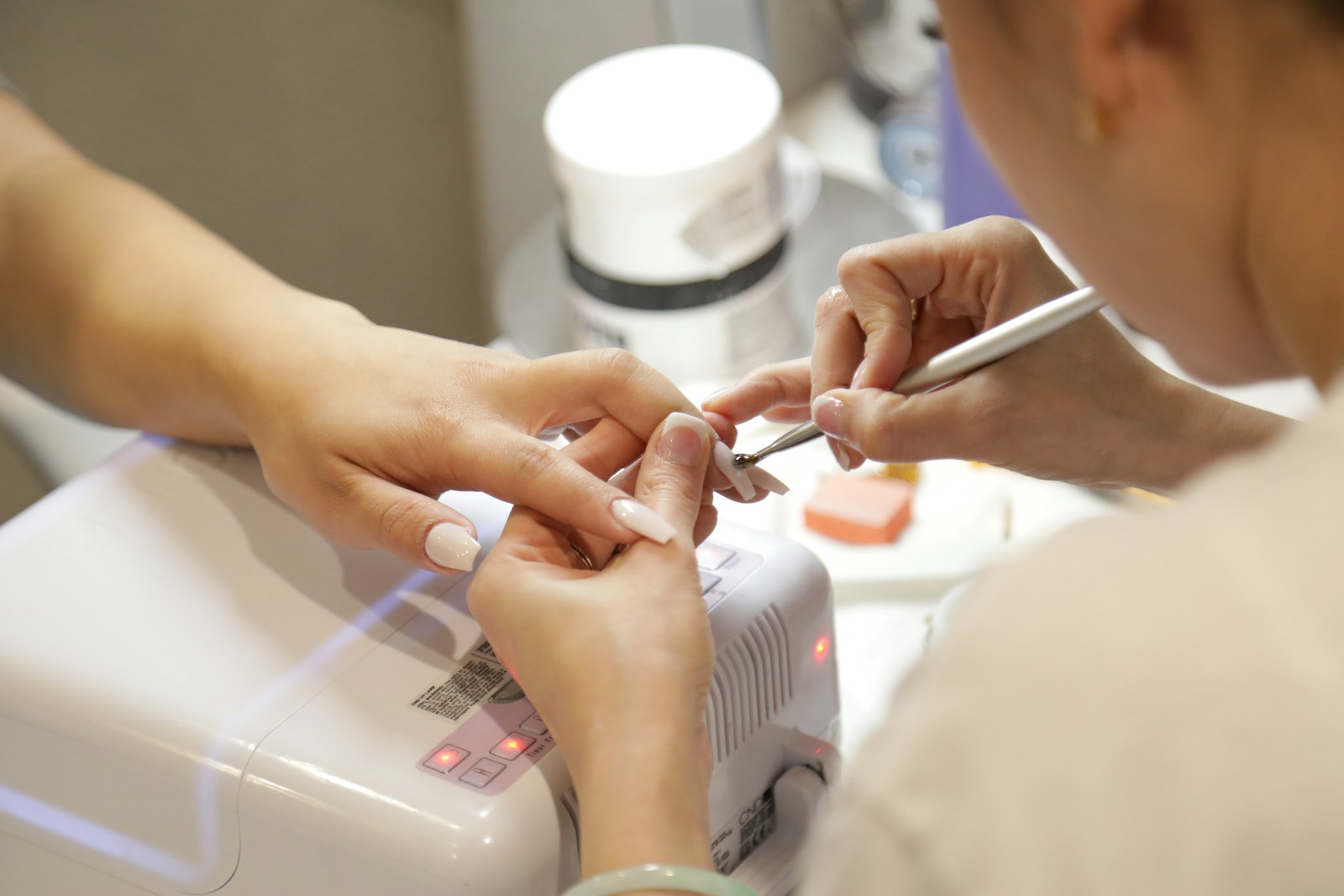


You know the smell. You push open the door of a nail salon and your nose files a complaint before your eyes have even found the colour wall. Most of us shrug it off because we are in and out within an hour, glossy and pleased with ourselves. A new study asks the uncomfortable follow-up question: what about the people who breathe that air all day, every day?
Published this week in the journal Risk Analysis, the research tracked air quality in five New York City nail salons and found that chemical levels do not simply hover in the background. They spike, again and again, throughout the working day. According to the authors, the way exposure is usually measured tends to smooth those spikes away.
What the researchers actually measured
The team, led by A. Michael Ierardi of the City University of New York Graduate School of Public Health and Health Policy, monitored each salon for about a week between April 2023 and March 2024. A data-logging photoionization detector recorded total volatile organic compounds (VOCs) every minute during working hours. On top of that, the researchers took chemical-specific samples to find out what exactly was floating around.
The answer will not surprise anyone who has ever removed a glitter manicure at home. The most common compounds were ethyl acetate, acetone, n-butyl acetate and methyl acetate: fast-evaporating solvents typical of polishes and removers. Xylenes, methyl methacrylate, benzene and ethyl methacrylate showed up less often and at lower concentrations.
The numbers, as reported by ScienceAlert: the average VOC concentration across salons was 15.1 parts per million. Peaks averaged over 15-minute windows were notably higher, with a median of 31.4 ppm. One salon hit 113 ppm. Ierardi described those peaks as comparable to levels seen in industrial settings, although the coverage does not specify which facilities he used for that comparison.
Why the average is the problem
The core of the study is more interesting than any single number. Workplace exposure is typically assessed as an average over an eight-hour shift. That may work better in settings where emissions are fairly steady. In the salons studied, concentrations jumped, fell and jumped again across the day. The study did not pin down what caused each individual peak, but anyone who has watched a busy salon at work can picture the candidates.
“This research shows that traditional air sampling and risk assessment methods don’t tell the whole story for nail salons,” Ierardi said in the press release from the Society for Risk Analysis. Think of it like judging a horror film by its average volume: technically quiet, until it is not.
The authors also point out that occupational exposure limits are generally designed to protect healthy, non-pregnant adult men over an eight-hour shift. Nail technicians are frequently women, many of them of reproductive age. As ScienceAlert notes, many also come from underserved communities. Limits calibrated for one body type may simply not fit another.
What the risk estimates say and what they do not
This is where precision matters, so let us be careful. Benzene appeared only at relatively low concentrations. Even so, the modelled lifetime cancer risk exceeded the US Environmental Protection Agency’s benchmark of one in a million in several salons under certain exposure scenarios. Estimates for non-cancer health effects were generally below the benchmark, though upper-bound estimates exceeded it in the salon with the highest concentrations.
These are risk models, not diagnoses. Ierardi stresses that the findings are not evidence that any worker has developed cancer. The study did not assess symptoms, did not identify the sources of individual peaks and did not examine customer exposure, which would require a separate analysis. Five salons in one city is also a small sample. The researchers say future work needs to look at actual health outcomes over time.
From Legally Blonde to labour safety
Pop culture has always loved the nail salon as a stage. In Legally Blonde, Paulette’s salon is where Elle Woods finds a friend, a cause and the bend and snap. Nail colour itself has been big business since Revlon launched with a nail enamel in 1932. What rarely makes it into the script is the ventilation system.
The US nail care industry is worth around $8 billion a year, according to the study’s press materials. That money flows through small businesses where installing proper ventilation can be expensive, noisy and hard to fit into a narrow shopfront. Industrial workers, by contrast, typically get more oversight, more airflow and more protective equipment.
What can change and what you can do
The coverage of the study lists practical measures: good ventilation first, then opening doors and windows where possible, keeping product containers closed and storing chemical-soaked materials in covered bins. ScienceAlert notes that surgical or cloth masks do not protect against chemical fumes.
Your role as a client is smaller but not zero. Ierardi says customers can help by supporting technicians who wear protective equipment rather than pressuring them to take it off, citing earlier research suggesting that kind of pressure happens. If your technician wears a respirator, treat it as basic occupational health rather than a vibe killer.
The bigger shift has to come from regulators and salon owners. This study offers them a sharper tool: measure the peaks, not just the mean. Beauty culture already obsesses over the details of a perfect cuticle. Applying the same attention to the air in the room seems like a reasonable next step.
This article is for general information only and does not replace professional medical advice. If you have health concerns related to chemical exposure at work, please speak to a doctor or an occupational health specialist.
Key facts at a glance
- What: A study in the journal Risk Analysis measured volatile organic compounds minute by minute in five New York City nail salons.
- Who: The research was led by A. Michael Ierardi of the CUNY Graduate School of Public Health and Health Policy and released by the Society for Risk Analysis on 5 November 2026.
- Findings: Average VOC levels were 15.1 ppm, the median 15-minute peak was 31.4 ppm and one salon reached 113 ppm, according to ScienceAlert.
- Risk: Modelled lifetime cancer risk from benzene exceeded the EPA benchmark of one in a million in several salons under certain scenarios; the study did not assess actual illness.
- Note: for general information only, not medical advice.
FAQ
Is nail salon air harmful to workers?
The new Risk Analysis study found repeated chemical spikes in five New York City nail salons and modelled elevated cancer risk from benzene under some scenarios. It did not measure actual health outcomes in workers.
Which chemicals were found in nail salon air?
The most common were ethyl acetate, acetone, n-butyl acetate and methyl acetate. Benzene, xylenes and methacrylates were found less often and at lower levels.
How can nail salons reduce chemical exposure?
Coverage of the study recommends proper ventilation, open doors and windows where possible, closed product containers and covered bins for chemical-soaked materials. Surgical or cloth masks do not protect against chemical fumes.
Sources
- Study identifies inhalation risks from chemical exposures in New York City nail salons (Society for Risk Analysis via EurekAlert)
- Nail Salon Air Can Spike to Levels Comparable to Chemical Plants (ScienceAlert)
- Nail salon workers face underestimated risks from chemical exposure (News-Medical)
- Estimation of Excess Inhalation Non-cancer and Cancer Risk from Volatile Organic Compound Mixtures in New York City Nail Salons (Risk Analysis)