Somewhere above the runway in the Cour Carrée of the Louvre on Tuesday evening, a Damier-patterned flying car was hovering while Zendaya, Emma Stone and Catherine Deneuve looked on. If you grew up with Saturday morning cartoons, your first thought was probably Judy Jetson. If you grew up with fashion magazines, it was Pierre Cardin. Both answers are correct. Nicolas Ghesquière would probably take either one as a compliment.
Louis Vuitton Spring 2027 closed Paris Fashion Week on October 6 as the final show of a nine-day schedule. The set promised science fiction. The clothes delivered something more surprising: lightness. Ghesquière titled the collection “Ergonomie”, a word that usually lives in office furniture catalogs next to adjustable lumbar support. On his runway it sounded like a manifesto.
A spaceport in the most classical courtyard in Paris
The staging did what Louis Vuitton staging does best. It made the Louvre’s centuries-old façades look as if they had been waiting for the future all along. Retro-futuristic shuttles stood on the ground and hung in the air, painted with color-blocked stripes and the house’s Damier check. The Zoe Report described the effect as a space-age highway, while the South China Morning Post saw a futuristic cityscape with a runway shaped like a race track.
Either way, the reference point is clear. Louis Vuitton started out as a trunk maker in 1854 and has spent much of this century reminding you that its real product is travel, or at least the fantasy of it. Ghesquière simply moved the destination a few centuries forward. According to FashionNetwork.com, the palette came straight from the airfield: grey, silver and yellow, a nod to the markings on airport runways. Add the mustard scarves and limoncello outerwear spotted by The Zoe Report and you have a wardrobe that would look equally at home in a departure lounge or on the bridge of the Starship Enterprise.
Ergonomie: clothes that move when you do
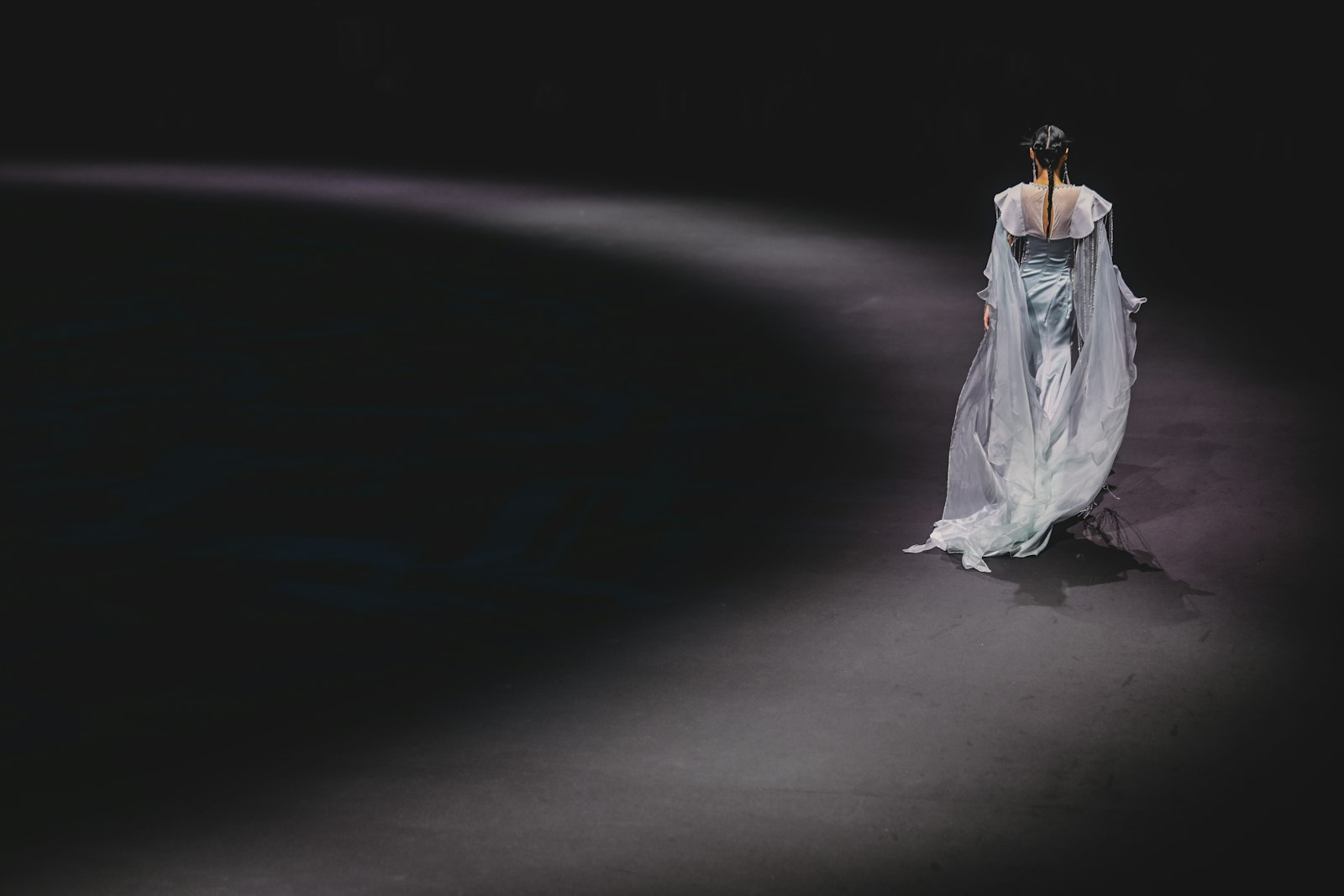
For a designer famous for sculpted shoulders and armor-like structure, this was a quiet change of direction. The opening looks were composite dresses in mesh and featherlight fabric, with textiles that FashionNetwork compared to cigarette paper. The Impression counted slinky jersey, technical nylon and second-skin dresses that followed the body instead of correcting it. Ghesquière’s own explanation was short and quotable: “Nothing is rigid, everything is fluid, like a second skin.”
That does not mean the collection went soft on detail. There were straight dresses with 1960s silhouettes plus monogrammed aviator jackets. Sheer organza midi dresses carried prismatic geometric patterns. Jeweled headpieces covered the upper face like a visor. Reflective paper diamonds caught the light. Leather jackets with checked sleeves nodded to Victorian robes, which is the kind of time travel only a fashion show can pull off without a flux capacitor. One practical note from FashionNetwork: the bags got smaller, a move aimed at a broader group of customers.
Why the Space Age keeps coming back
Fashion has been here before. It was glorious. In 1964 André Courrèges sent out his white and silver Moon Girl collection. Pierre Cardin built an entire aesthetic around the space race, while Paco Rabanne presented dresses made of metal and plastic in 1966 and later worked on the costumes for Barbarella. Those designers dressed a generation that believed it was going to the moon, which it did in 1969.
The 1960s silhouettes on Ghesquière’s runway are a direct quotation from that era. What changed is the mood. The original Space Age imagined the future as conquest, stiff and gleaming. Ghesquière’s version imagines the future as comfort. His clothes do not ask you to stand still and look like a rocket. They ask you to move.
He has history with the subject. At Balenciaga, where he spent about 15 years before joining Louis Vuitton in 2013, his gold robot leggings for spring 2007 became one of the most discussed runway pieces of the decade. For him, science fiction is less a theme than a native language.
Lightness as the real luxury statement
Interpretation time, so consider yourself warned. Over the past year Paris has absorbed a wave of new creative directors at houses such as Dior, Chanel and Balenciaga, each debut a headline of its own. In that context the most established designer on the schedule chose not to shout. Ghesquière has led Louis Vuitton womenswear for almost 13 years, longer than many of his peers have stayed anywhere. Four days before the show, on October 2, President Emmanuel Macron made him a Chevalier of the Légion d’honneur, reports Journal du Luxe. A designer who has just received France’s highest order of merit could be forgiven for building a monument. He built a mesh dress instead.
Our reading: when luxury risks feeling distant, the promise that something will feel good on your body is a smarter pitch than another impossible silhouette. The smaller bags point in the same direction. That is our analysis, not a statement from the house, but the clothes make a persuasive case for it.
What it means for your wardrobe
You will probably not be hailing a Damier hover car anytime soon. The ideas travel well, though. A sheer mesh layer over a simple tank is the easiest way into the collection’s mood. A straight 1960s shift worn with flat shoes feels current without trying too hard. One metallic silver piece next to grey, finished with a single hit of mustard yellow, borrows the runway palette without turning you into an extra from Barbarella.
The last word of the season
Closing Paris Fashion Week means Louis Vuitton also gets to write the season’s final sentence. Ghesquière wrote it in the softest possible font. After a year in which fashion argued loudly about who would lead which house, the veteran in the Louvre courtyard suggested that the next big idea might be a garment you forget you are wearing. In the world of Louis Vuitton Spring 2027 the future does not arrive in a rocket. It arrives in something you can actually sit down in.
Key facts at a glance
- What: Louis Vuitton presented its Spring/Summer 2027 womenswear collection, titled Ergonomie, as the final show of Paris Fashion Week.
- When and where: The show took place on Tuesday, October 6, 2026, in the Cour Carrée of the Louvre in Paris.
- Who: Nicolas Ghesquière has designed Louis Vuitton womenswear since 2013 and was made a Chevalier of the Légion d’honneur on October 2, 2026.
- Set: Retro-futuristic shuttles decorated with stripes and the Damier pattern stood on the ground and hung above the runway.
- Clothes: The collection focused on featherlight mesh, jersey and technical nylon in a palette of grey, silver and yellow.
FAQ
What was the theme of Louis Vuitton Spring 2027?
The collection was titled Ergonomie and focused on light, fluid clothes designed around the body in motion. The set added a retro-futuristic touch with Damier-patterned shuttles in the Louvre’s Cour Carrée.
When was the Louis Vuitton Spring 2027 show?
Louis Vuitton showed its Spring 2027 collection on Tuesday, October 6, 2026, as the closing show of Paris Fashion Week.
Who designs Louis Vuitton womenswear?
Nicolas Ghesquière has been artistic director of Louis Vuitton womenswear since 2013. Before that he spent about 15 years at Balenciaga.
Sources
- “Ergonomics”: At Louis Vuitton, veteran Ghesquière has last word of the season (FashionNetwork.com)
- Louis Vuitton Spring/Summer 2027 Was A Futuristic Ride To A Galaxy Far Far Away (The Zoe Report)
- Louis Vuitton Spring 2027 Fashion Show Review (The Impression)
- Louis Vuitton unveils futuristic, minimalist SS27 collection at Paris Fashion Week (South China Morning Post)
- Nicolas Ghesquière élevé au rang de chevalier de la Légion d’honneur (Journal du Luxe)
- Paris Fashion Week S/S 2027: everything you need to know (Wallpaper)