Somewhere in Milan this week, a room full of luxury executives learned that their industry is growing again. Then they learned which part of it is growing. Roughly half of them probably went back to their hotel rooms to stare at the minibar. The new Bain luxury study 2026, presented on November 18 with the Italian luxury association Altagamma, says the personal luxury goods market will reach about €367 billion this year. That is a gain of 1 to 3 percent at current exchange rates after two years of slight decline. Good news, technically. The catch is in the fine print: luxury now runs at two very different speeds.
Wondering why your favorite boutique suddenly has more rings and fewer shoes? This report is your answer key.
Two speeds, one very uneven runway
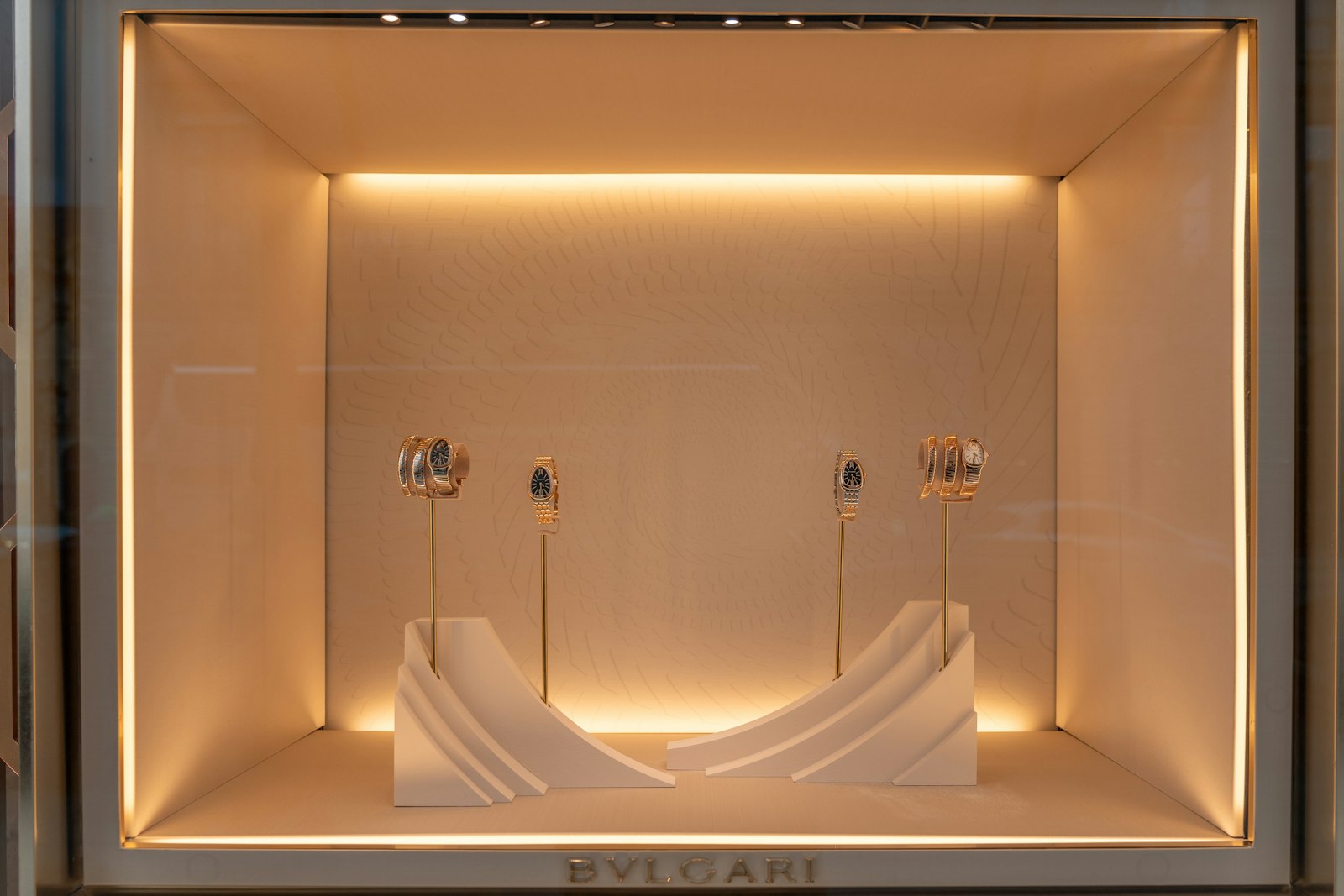
The headline number hides a split that Bain describes openly. Jewelry is expected to grow by 8 to 10 percent in 2026, the strongest of any category. Eyewear follows at 4 to 6 percent and watches at 3 to 5 percent. Apparel manages 1 to 3 percent. Leather goods, the handbag business that powered a decade of luxury profits, sits at 0 to 2 percent. Shoes bring up the rear with a decline of 3 to 5 percent.
Bain puts it even more bluntly: more than 70 percent of hard luxury players (jewelry and watches) are growing, while about 60 percent of soft luxury brands (fashion and leather goods) are flat or shrinking. Carrie Bradshaw once explained that she likes her money where she can see it, hanging in her closet. In 2026 the money apparently prefers to sit on a finger.
Why jewelry? Bain points to self-purchase, everyday wear and renewed creativity across price points. Read that as a cultural shift rather than a sales trick. A ring or a chain is something you wear every single day, it does not go out of style next season and it rarely ends up in a sample sale. Holly Golightly only looked through the window at Tiffany. Today’s customer walks in and buys for herself, no Paul Varjak required.
The shrinking club of luxury shoppers
The more uncomfortable number concerns people, not products. According to Bain, the number of personal luxury buyers has fallen to around 315 million in 2026, down from 330 million last year and roughly 400 million in 2022. In four years the industry has lost a crowd the size of a large country.
Last year Bain spoke of a broken price and value equation, which is consultant language for customers who looked at a price tag and walked out. This year’s report shows where they went. The overall luxury market, including experiences and assets such as cars, art and yachts, holds steady at about €1.5 trillion. Experiential luxury alone is worth around €533 billion and is growing by 2 to 4 percent. Lead author Claudia D’Arpizio, who heads Bain’s global fashion and luxury practice, said the market is “neither simply slowing down nor recovering; it is redefining its boundaries.” Reuters quoted her describing “a shift away from personal goods towards other forms of indulgence.”
In plain terms: a dinner, a trip or a hotel weekend now competes directly with a handbag. And the handbag is losing some of those fights.
America up, China down, the Gulf on pause
Geography adds a second split. Bain expects personal luxury spending in the Americas to grow by 7 to 9 percent in 2026, with Japan and the rest of Asia outside mainland China at 5 to 7 percent. Europe is forecast at 1 to 3 percent. Mainland China slips by 1 to 3 percent, while the Middle East, Africa and Oceania drop by 10 to 14 percent, a fall that Reuters and Bain link to the war involving Iran.
China deserves a closer look, because the story there is not only about weaker spending. Bain reports that the intention to buy local brands in China is six times higher than in 2019. Co-author Federica Levato told Reuters that local consumers, “starting with Gen Z,” have shifted toward local labels that are “taking market share.” For European houses that spent twenty years treating Shanghai as an endless cash machine, that is a strategic problem rather than a cyclical dip. It also adds context to the recent decisions by Gucci and Dior to stage their Cruise 2028 shows in Shanghai: you do not court a market this hard unless you are worried about losing it.
Grandparents, resale and the robots
Where does growth come from next? Bain names three places. None of them looks like the influencer mood board of 2019.
First, older customers. Boomers, the Silent Generation and Gen X together account for 45 to 55 percent of spending. Bain estimates that their growing participation could add €300 to 600 billion in cumulative value between 2026 and 2030. After years of chasing Gen Z on TikTok, the industry may rediscover the people who can actually afford the product. Iris Apfel, who became a fashion icon in her eighties, would have approved.
Second, resale. Bain says the pre-owned market grew 7 to 8 percent a year between 2019 and 2025, three to four times faster than the primary market. It expects the segment to grow by 4 to 6 percent this year. The secondhand Birkin is no longer a niche hobby. It is a parallel economy.
Third, artificial intelligence. According to Bain, 70 percent of AI prompts about luxury do not name a brand at all. Visitors referred to luxury sites by AI tools generate more than 40 percent higher revenue per visit. Translation: when you ask a chatbot for “a good everyday gold necklace,” the brand that the machine recommends wins. Miranda Priestly’s famous cerulean speech in The Devil Wears Prada explained how a color travels from the runway to the bargain bin. The 2026 version would need a paragraph about search algorithms.
What this means for you
The facts come from Bain. The interpretation is ours: brands are under pressure to justify their prices. D’Arpizio told the Italian press that the houses have read the mood of the moment and avoided excessive price increases this year. For you as a shopper, that could mean more careful pricing and more emphasis on craftsmanship in fashion and leather goods, while jewelry brands keep their confidence because demand is on their side.
For 2027, Bain expects personal luxury goods to grow by 0 to 4 percent at constant exchange rates in its base scenario, with a downside below zero and an upside of 4 to 6 percent. That is a forecast rather than a promise. It rests on volatile factors such as American wealth, Chinese consumer confidence and the situation in the Middle East.
The deeper message is that luxury is being forced to answer a question it avoided during the boom years: what exactly are you paying for? Levato’s answer was that the winners will be those who deliver something that “feels worth choosing at every level.” The industry has had a lot of practice making things desirable. Now it has to make them worth it, which is a different skill altogether.
Key facts at a glance
- What: The Bain and Altagamma luxury study 2026, presented in Milan on November 18, 2026, puts the personal luxury goods market at about €367 billion this year.
- Growth: Personal luxury goods are expected to grow by 1 to 3 percent at current exchange rates in 2026 after two years of slight decline.
- Winners: Jewelry is the strongest category with expected growth of 8 to 10 percent while shoes are forecast to decline by 3 to 5 percent.
- Customers: Bain estimates the number of personal luxury buyers fell to about 315 million in 2026 from roughly 400 million in 2022.
- Outlook: Bain’s base scenario for 2027 is growth of 0 to 4 percent at constant exchange rates for personal luxury goods.
FAQ
What does the Bain luxury study 2026 say about the luxury market?
The study says personal luxury goods will reach about €367 billion in 2026, a gain of 1 to 3 percent at current exchange rates. Growth is uneven, with jewelry and the Americas growing while shoes, mainland China and the Middle East decline.
Why is jewelry growing faster than fashion in the luxury market?
Bain attributes jewelry’s expected growth of 8 to 10 percent to self-purchase, everyday wear and renewed creativity across price points. Fashion and leather goods grow far more slowly or not at all.
How many luxury customers are there in 2026?
Bain estimates about 315 million people bought personal luxury goods in 2026. That is down from 330 million in 2025 and around 400 million in 2022.
Sources
- Global luxury holds steady at €1.5 trillion as experiences and new consumer priorities reshape growth (Bain & Company)
- Luxury holds its ground in 2026 with new opportunities ahead (Bain & Company)
- Luxury goods sales seen returning to growth in 2026 but outlook fragile (Reuters via BNN Bloomberg)
- Bain’s luxury market study (JCK)
- Lusso stabile a 1.500 miliardi nel 2026 (Pambianconews)
- Il lusso supera quota 1.500 miliardi di euro (MF Milano Finanza)
- Global luxury stays resilient despite economic headwinds (Bain & Company, 2025)
This article was created with AI assistance and is based on the sources listed.