
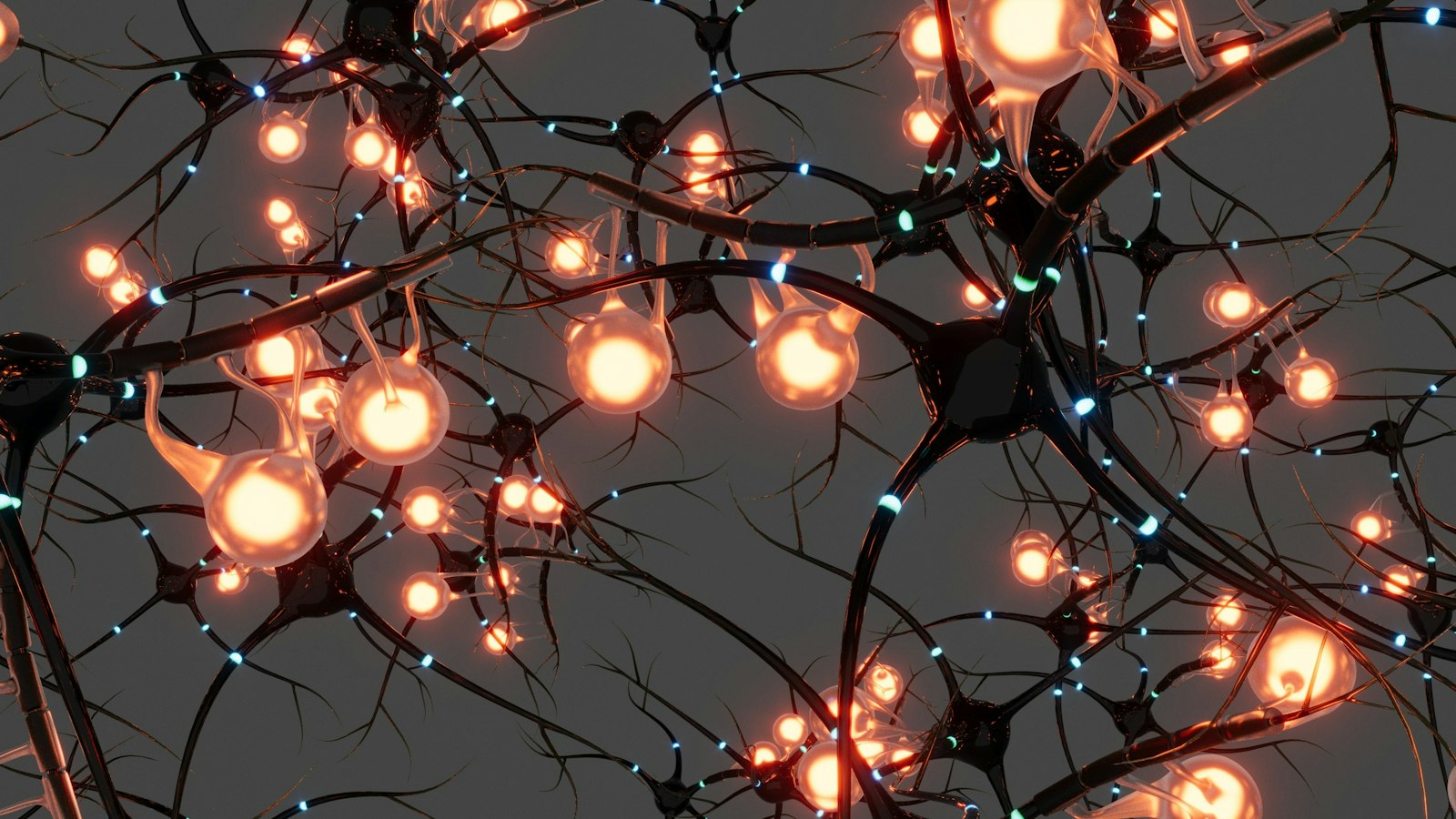


For years you have been told to keep blue light away from your brain at bedtime. On Monday, three scientists won a Nobel Prize for doing the exact opposite, on purpose and one nerve cell at a time. The 2026 Nobel Prize in Physiology or Medicine goes to Karl Deisseroth of Stanford University, Peter Hegemann of Humboldt University of Berlin and Georg Nagel of the University of Würzburg for the discovery of light-gated ion channels and the development of optogenetics.
The prize of 12 million Swedish kronor is split equally between the three. The ceremony takes place on December 10 in Stockholm. Behind the formal citation sits a very good story: a pond alga, a German lab bench and a technique that changed how scientists study the brain. It also comes with an unusually honest footnote from one of the winners.
Meet the alga with an eye for light
The hero of this story is Chlamydomonas, a single-celled green alga that swims toward light. To do that, it needs some way to sense where the light is coming from. In the 1990s, Peter Hegemann identified a light-sensitive protein in the alga’s eyespot. In the early 2000s, work by Hegemann and Nagel revealed something remarkable about these proteins, which became known as channelrhodopsins. They turned out to be channels in the cell membrane that open when light hits them and let charged particles flow through.
That detail is what made the discovery so powerful. Neurons communicate through exactly this kind of flow of charged particles. A protein that converts light directly into an electrical signal is, in effect, a light switch for a cell. Two versions became famous: ChR1 and then ChR2, which responds to blue light.
There is a nice German footnote too. Würzburg, where Nagel works, is the same university town where Wilhelm Conrad Röntgen discovered X-rays in 1895. Apparently the place has a habit of producing new ways to look inside the human body.
From pond scum to brain science
The leap from algae to neuroscience came at Stanford. In 2005, Karl Deisseroth’s team published a study in Nature Neuroscience showing that rat nerve cells carrying ChR2 could be switched on with millisecond precision using pulses of blue light. The first author was Ed Boyden, now at MIT. Feng Zhang was second author. In 2007 the method worked in living mice.
To understand why this mattered, picture a DJ who can only turn the volume of the whole club up or down. That was roughly the situation for neuroscientists who used electrodes, which activate everything nearby. Optogenetics gave them the mixing desk. By inserting the light-sensitive protein only into specific types of neurons, researchers can switch exactly those cells on or off and watch what happens to behavior.
The technique has since been used to study the sleep and wake cycle, to locate the physical traces of memories and to map the dopamine circuits involved in motivation and reward. Per Svenningsson, chair of the Nobel Committee, said optogenetics allows scientists to map the brain “in a way that we could once only dream of.”
The medicine is still catching up
Here comes the footnote. According to R&D World, Georg Nagel told CNN that he knows of only one patient who has benefited from optogenetics so far and that he thought it was still too early for a medicine prize. It is rare to see a laureate manage expectations on the very day of the call from Stockholm. It is also refreshing, given how quickly breakthroughs get turned into miracle headlines.
The most advanced clinical efforts target retinitis pigmentosa, a hereditary eye disease in which the light-sensitive cells of the retina die while other retinal cells survive. The idea is to make those surviving cells sensitive to light. In September 2026, the US Food and Drug Administration accepted an application from Nanoscope Therapeutics for its optogenetic gene therapy Mogenry, with a decision expected in the first half of 2027, R&D World reports. The company says patients in its trials maintained an average improvement of roughly three lines on a standard eye chart after three years. Those are company-reported results and the therapy is not approved.
Other projects are earlier in development. GenSight Biologics is testing a therapy that is combined with special goggles that project light onto the retina, while Ray Therapeutics is running trials of its own candidate. Optogenetics is currently not a treatment for brain diseases in humans. In neuroscience it remains first and foremost a research tool, mostly used in animal studies.
What this means for you
Most likely you will never be treated with optogenetics directly. You have, however, almost certainly read news about brain research that relied on it. Many of the studies behind headlines about memory, sleep or reward circuits in recent years used the method in animals.
One warning, offered with a raised eyebrow: expect the wellness industry to discover the word “optogenetic” any minute now. LED face masks, red light panels and blue light glasses have nothing to do with it. Optogenetics only works when cells have been genetically equipped with a light-sensitive protein. Without that step, light is just light.
This year’s Nobel follows a pattern the committee likes: rewarding a tool rather than a cure, much as the chemistry prize honored the gene scissors CRISPR in 2020. Tools take a long time to turn into therapies, but they change what science is able to ask. If the FDA approves the first optogenetic treatment next year, Georg Nagel will have to update his patient count. Few scientists would be happier to be proven wrong.
This article is for general information only and does not replace medical advice from a doctor or other qualified health professional.
Key facts at a glance
- What: The 2026 Nobel Prize in Physiology or Medicine honors the discovery of light-gated ion channels and the development of optogenetics.
- Who: The laureates are Karl Deisseroth of Stanford University, Peter Hegemann of Humboldt University of Berlin and Georg Nagel of the University of Würzburg.
- Prize: The award of 12 million Swedish kronor is shared equally and will be presented on December 10, 2026.
- Status: The FDA has accepted an application for Mogenry, an optogenetic gene therapy for retinitis pigmentosa by Nanoscope Therapeutics, with a decision expected in the first half of 2027.
- Note: for general information only, not medical advice.
FAQ
Who won the Nobel Prize in Physiology or Medicine 2026?
Karl Deisseroth, Peter Hegemann and Georg Nagel won the 2026 Nobel Prize in Physiology or Medicine. They were honored for discovering light-gated ion channels and developing optogenetics.
What is optogenetics?
Optogenetics is a method in which nerve cells are genetically equipped with light-sensitive proteins so they can be switched on or off with light. It is mainly used as a research tool in animal studies.
Is there an approved optogenetic therapy?
No optogenetic therapy has been approved so far. The FDA is reviewing Nanoscope Therapeutics’ gene therapy Mogenry for retinitis pigmentosa with a decision expected in the first half of 2027.
Sources
- Press release: Nobel Prize in Physiology or Medicine 2026 (NobelPrize.org)
- 2026 Nobel Prize for Physiology or Medicine Goes to Optogenetics, Light-Gated Ion Channels (GEN)
- 3 Scientists Share Nobel Prize in Physiology or Medicine for Optogenetics (AJMC)
- Deisseroth, Hegemann, Nagel Win 2026 Nobel for Optogenetics (Mexico Business News)
- Optogenetics just won the Nobel Prize, its first therapy is already under FDA review (R&D World)