
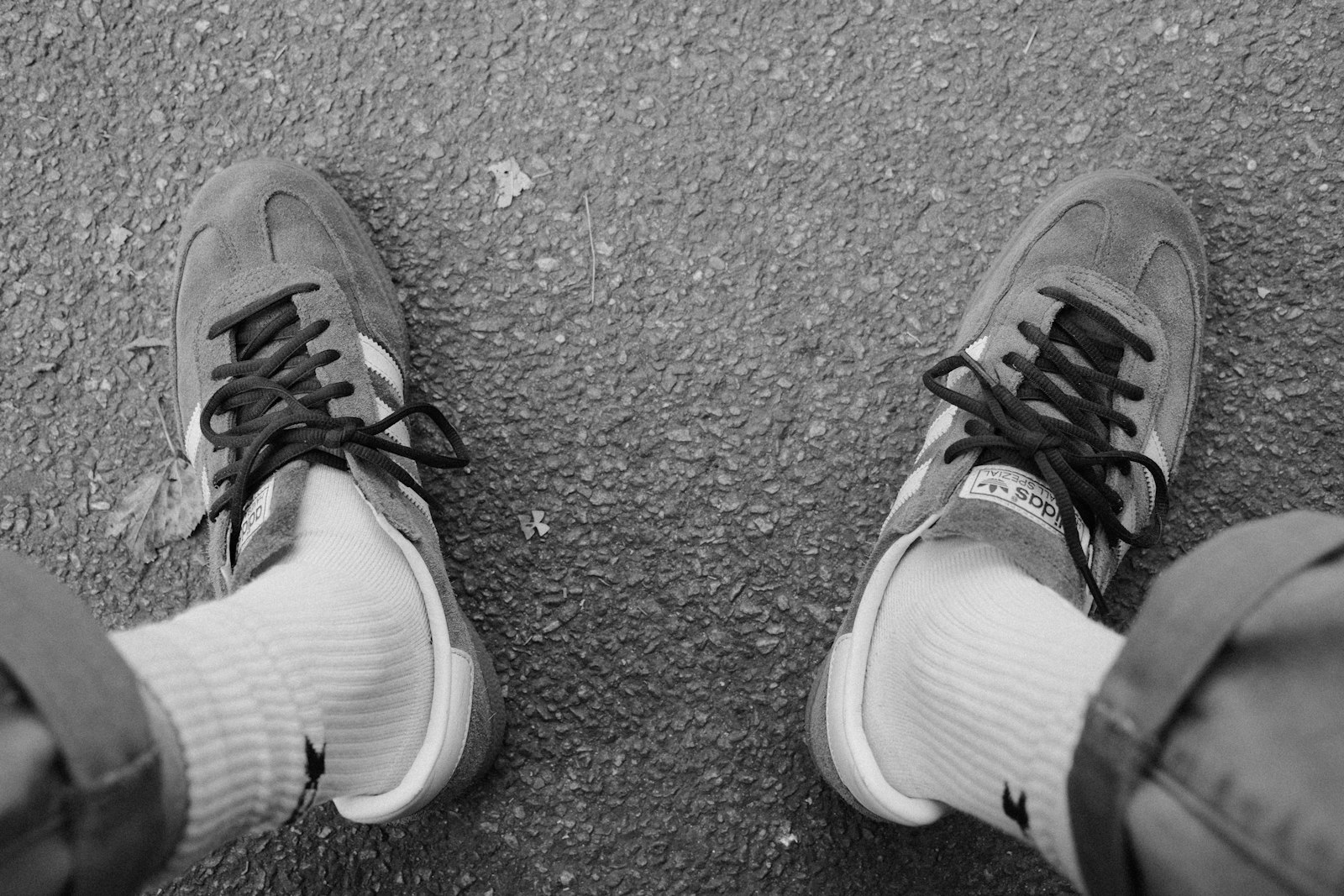


Somewhere in Herzogenaurach there is probably a spreadsheet that looks like a very good mood. Adidas has just posted the best quarter in its history. Revenue up, margins up, profit up by more than a third. And yet the most interesting sentence in the whole announcement came from the boss himself, who admitted that one of the brand’s most famous businesses is stuck in traffic: lifestyle sneakers, the shoes you wear to brunch rather than to the gym.
So if you are wondering whether the terrace sneaker on your feet is still a fashion statement or already a market problem, you have come to the right financial report. We promise to keep the decimal points to a minimum.
What Adidas actually reported
On Tuesday, October 20, 2026, after the stock market closed, Adidas released preliminary figures for its third quarter. Revenue rose 9 percent to a record 7.25 billion euros. Adjusted for currency effects, growth was 7 percent. The gross margin improved by 2.5 percentage points to 54.3 percent, a figure analysts watch the way stylists watch hemlines. Operating profit climbed 37 percent to roughly 1.01 billion euros, the highest quarterly operating profit the company has ever recorded.
Adidas raised its full-year outlook as well. The company now expects an operating profit of about 2.5 billion euros for 2026, up from the roughly 2.3 billion it had previously forecast. Its target for currency-neutral revenue growth of 9 to 10 percent stays unchanged. Shares rose 2.6 percent on the Tradegate platform after the news. The full quarterly results, with the detail that preliminary releases politely leave out, are due on October 29.
The 200 million euro plot twist
Before you start picturing every Gazelle in the world flying off the shelves at full price, there is a footnote worth reading. About 200 million euros of the quarter came from a refund of US customs duties. Adidas says it has now received most of its tariff claims. That money flowed straight into the gross margin.
The legal backdrop helps explain the timing. In February 2026 the US Supreme Court struck down the tariffs that had been imposed under the International Emergency Economic Powers Act. The US Court of International Trade later ordered refunds. Adidas has not spelled out every line of its claim in the preliminary release, so how much of the refund traces back to which tariffs remains a question for the October 29 report. What is clear: a meaningful slice of this record quarter was a one-off, a bit like a vintage find you will not stumble across twice.
That is also why the new forecast is 2.5 billion and not more. According to the company, the refund plus about 100 million euros of stronger underlying profit would have pointed to roughly 2.6 billion. Adidas plans to reinvest around 100 million euros in the fourth quarter instead, in projects meant to pay off later. Translated from investor language: the brand would rather buy itself a better 2027 than a prettier December.
Clothes are carrying the stripes
The more revealing story sits inside the product mix. Demand for apparel is strong and is driving the lifestyle segment, while lifestyle footwear is having a harder time. Chief executive Bjørn Gulden did not sugarcoat it. He blamed the slowdown on “too much inventory and too much discounting in the marketplace” and added that “we know this will soon normalize again.”
Note the word marketplace. Gulden is describing an industry problem rather than an Adidas problem alone. When retailers sit on too many pairs, they cut prices. When prices fall, brands lose margin and a little bit of mystique. A sneaker that every shop is discounting is no longer the shoe you queued for. It is the shoe you get with a voucher code.
Adidas is also not naming which models are affected, so any claim that a specific silhouette has peaked would be speculation. What we can say is that the company spent the last few years riding one of the loudest retro waves in recent sneaker history. Waves, as any surfer or trend forecaster will tell you, eventually reach the beach.
From frozen football pitches to brunch
The irony is delicious if you know your archive. Adi Dassler founded the company in 1949 in the Bavarian town of Herzogenaurach. The Samba was born around that time as a football shoe built to grip hard, icy ground. The Gazelle arrived in the 1960s as a training shoe. None of them were designed to be photographed next to an iced oat latte.
Then culture took over. In 1986 Run-DMC released “My Adidas,” a love song to the Superstar that turned a basketball shoe into hip-hop uniform. British football terraces made the low-profile trainers a tribal code. Decades later, fashion week guests rediscovered the same slim shapes and gum soles. Social media did the rest. The cycle from niche to everywhere has never been faster, which is precisely the problem Gulden is describing: everywhere is wonderful for sales until it becomes too much of everywhere.
The discipline speech
For a company that has just broken its own records, the tone of the announcement is strikingly restrained. “In this environment we are not trying to maximize the short-term,” Gulden said, while also stating that the brand’s investment in innovation is paying off. That phrasing fits his broader message of staying disciplined and focusing on medium-term goals rather than squeezing every last euro out of a hot product.
This is our interpretation, but it reads like a lesson the whole industry learned the hard way. Brands that flood the market with a hit model tend to pay for it later with clearance racks and a cooler image. Holding back supply, protecting full-price sales and shifting attention to apparel looks like an attempt to land the retro boom softly instead of crashing it.
What this means for you
If you are shopping for sneakers this season, the market Gulden describes is good news for your wallet. Excess inventory and discounting usually mean more sales, at least until the stock clears. If you care more about wearing something that still feels early, look at the clothes. That is where Adidas says the momentum is. History suggests the brand knows how to turn a tracksuit into a statement. Just ask anyone who wore one in a music video in the 1980s.
The bigger question is whether the record quarter marks a peak or a pause. Without the tariff refund the numbers would still be strong, but less spectacular. The October 29 report should show how much of the growth is repeatable and how quickly the sneaker shelves empty out. Until then, the three stripes look less like a brand in trouble and more like one that has learned to read its own hype cycle. In fashion, that might be the rarest skill of all.
Key facts at a glance
- What: Adidas reported preliminary third quarter 2026 revenue of a record 7.25 billion euros, up 9 percent or 7 percent on a currency-neutral basis.
- Profit: Operating profit rose 37 percent to about 1.01 billion euros, the highest quarterly figure in company history, while the gross margin rose to 54.3 percent.
- Tariff refund: About 200 million euros of the quarter came from a refund of US customs duties, which lifted the gross margin.
- Outlook: Adidas now expects 2026 operating profit of about 2.5 billion euros instead of about 2.3 billion and plans to reinvest around 100 million euros in the fourth quarter.
- Status: Full third quarter results are scheduled for October 29, 2026.
FAQ
How did Adidas perform in Q3 2026?
Adidas had a record third quarter in 2026 with revenue of 7.25 billion euros and operating profit of about 1.01 billion euros. Both figures are preliminary until the full report on October 29.
Why did Adidas get a tariff refund?
Adidas received about 200 million euros in refunds of US customs duties after most of its tariff claims were granted. Earlier in 2026 the US Supreme Court struck down tariffs imposed under emergency powers legislation and a trade court ordered refunds.
Why are Adidas lifestyle sneakers struggling?
CEO Bjørn Gulden blamed too much inventory plus heavy discounting across the market for weak lifestyle footwear sales. He said he expects the situation to normalize soon.